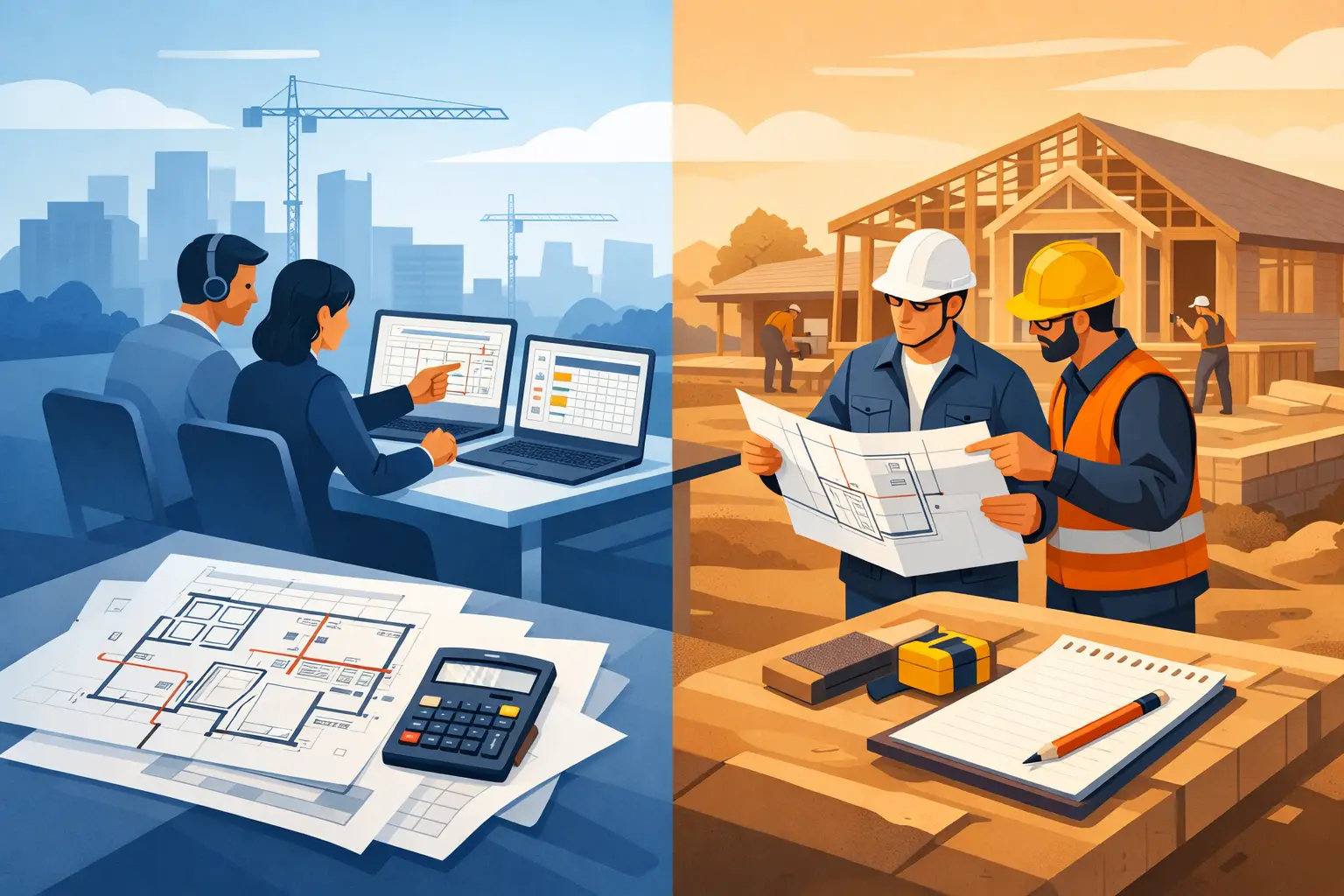
If your estimator is flat out, tenders are stacking up, and DA plans need pricing before the next client call, the outsourced estimating versus in-house decision stops being theoretical pretty quickly. For residential builders, it comes down to one question: where do you want the risk to sit - in fixed overhead, in tender turnaround, or in scope accuracy?
There is no universal winner. A volume builder with a stable product range has different needs from a custom builder pricing duplexes in Brisbane, a granny flat in Western Sydney, and a sloping single dwelling in regional Victoria. The right model depends on pipeline consistency, staff capability, project type, and how much rework your team can absorb before margin starts leaking.
Outsourced estimating versus in-house: what really changes
Most builders think this choice is about cost. It is partly about cost, but the bigger issue is capacity and control.
An in-house estimator gives you direct access to the person building your rates, interpreting the plans, and carrying knowledge from one job to the next. That matters when your construction methodology is specific, your preferred trades vary by region, or your sales team needs fast feedback on design changes. You can walk over, mark up a plan, and get an answer in real time.
Outsourced estimating changes that model. Instead of paying for full-time capacity whether you use it or not, you buy estimating output when needed. If the service is structured properly, you also get a cleaner handover - measured quantities, BOQ logic, provisional allowances called out separately, and packs that can go straight to subcontractors for pricing. The upside is speed and reduced internal bottlenecks. The downside is that not every external provider understands how your business prices supervision, prelims, margin, wastage or buildability risk.
That is why the real comparison is not staff versus freelancer. It is uncontrolled internal workflow versus a repeatable estimating system.
Where in-house estimating works best
In-house estimating makes the most sense when your job flow is consistent enough to keep an estimator productive most weeks. If you are tendering similar housing product across the same regions, an internal team can refine historical rates, track subcontractor movements, and tighten estimate-to-actual performance over time.
There is also value in proximity. Your estimator knows which details your site team always changes, where your standard inclusions sit, and which consultants leave documentation gaps. That business knowledge does not always show up in a fee comparison, but it often shows up later in fewer scope misses.
For builders with complex custom work, internal estimating can also support better pre-construction decision-making. The estimator is sitting inside the business, alongside sales, drafting and construction. That means earlier advice on value engineering, realistic provisional allowances, and programme impacts before the tender goes out.
The catch is obvious. Good estimators are expensive, hard to hire, and harder to keep. If your pipeline drops, that overhead remains. If your estimator goes on leave or resigns mid-tender, the workflow can stall overnight. Some builders also end up with too much knowledge sitting in one person’s head, with very little process around it.
Where outsourced estimating has an edge
Outsourced estimating is strongest when demand is uneven, turnaround matters, or your internal team is spending too much time measuring instead of making commercial decisions.
That is especially relevant at DA stage. Builders often need an early but usable number to test feasibility, shape scope, and decide whether to pursue the job. Waiting several days for a full manual estimate can mean lost momentum with the client, delayed consultant coordination, or rushed tender decisions later.
A good outsourced model can remove the low-value manual work without removing your commercial control. If the output includes a builder-ready Cost Estimate Report, editable BOQ workbook, trade breakdowns, subcontractor pricing packs and an indicative construction programme, your team is not starting from scratch. They are reviewing, adjusting and finalising. That is a much better use of estimator time than measuring every wall, slab edge and roof area manually.
It also helps with regional spread. If you are pricing work across NSW, QLD and VIC, rate card logic and subcontractor coverage become more complicated. An outsourced provider with metro and regional rate frameworks can give you a stronger starting point than broad internal allowances based on the last job in a different market.
But outsourced estimating only works if the service is builder-usable. A PDF with a lump sum and vague assumptions is not enough. You need measured scope separated from provisional allowances, editable quantities, and enough structure in the BOQ to test trade pricing and margin before the job goes live.
The real trade-offs builders need to weigh up
The main argument for in-house is control. The main argument for outsourcing is capacity. Both are valid, and both can go wrong.
With in-house estimating, the risk is hidden inefficiency. A salaried estimator can still become a bottleneck if every tender depends on one person’s availability. Internal teams can also inherit inconsistent methods over time - one estimator measures retaining walls one way, another excludes them from the base BOQ, and nobody picks up the discrepancy until procurement.
With outsourced estimating, the risk is misalignment. If the provider does not understand your build method, trade coverage, preferred BOQ structure or margin settings, you can spend too much time correcting the estimate. At that point, you have not saved capacity. You have just moved the rework somewhere else.
There is also a timing question. If you need quick feasibility feedback on multiple DA-stage opportunities, outsourced estimating is often more efficient. If you are in final tender negotiation on a high-value custom home with multiple iterations and consultant changes, close in-house collaboration may still be the better fit.
A hybrid model usually makes more commercial sense
For many residential builders, the best answer is not outsourced estimating versus in-house as an either-or decision. It is a split model.
Keep commercial judgement in-house. Push measurement-heavy, repeatable estimate preparation into an external workflow that can turn plans and documents into usable pricing packs quickly. Your internal team can then focus on bid strategy, subcontractor comparisons, provisional-risk review, and client-facing decisions.
This approach works particularly well for smaller building companies that do not want full-time estimating overhead, and for larger teams where the estimator should be managing tender risk rather than doing basic take-offs all day. It also gives you resilience. If tender volume spikes, you can absorb it without immediately adding headcount.
That is where an automated service layer can outperform both traditional QS workflows and pure software tools. Builders do not just need measurement software. They need finished estimating outputs they can review and use. If the estimate lands typically the same day, with measured scope, editable BOQ logic, subcontractor packs and programme visibility, the internal conversation changes from “who has time to price this?” to “is this job commercially worth chasing?”
How to decide which model suits your business
Look at your last ten tenders, not your ideal future state. If turnaround was slow, scope gaps were common, or your estimator spent most of the week measuring instead of reviewing value, there is probably a workflow issue before there is a staffing issue.
If your tender volume is steady and your projects are highly standardised, in-house may give you the best long-term control. If your workflow is lumpy, your team is stretched, or you need early pricing before full documentation lands, outsourcing will likely reduce pressure and improve response time.
Also check what your output needs to do. If you only need a top-line feasibility number, one model may be enough. If you need something that can become the backbone of tendering - BOQ workbook, pricing packs, assumptions, dashboard totals and indicative programme - then the quality of the estimating system matters more than where the person sits.
For Australian residential builders, that decision should be made with real project conditions in mind: varying site constraints, consultant quality, metro versus regional labour and supply pricing, and the need to move quickly without carrying avoidable tender risk.
The builders who price well are usually not the ones doing everything internally or everything externally. They are the ones who know which parts of estimating need judgement, which parts need speed, and which parts should never be left to guesswork.