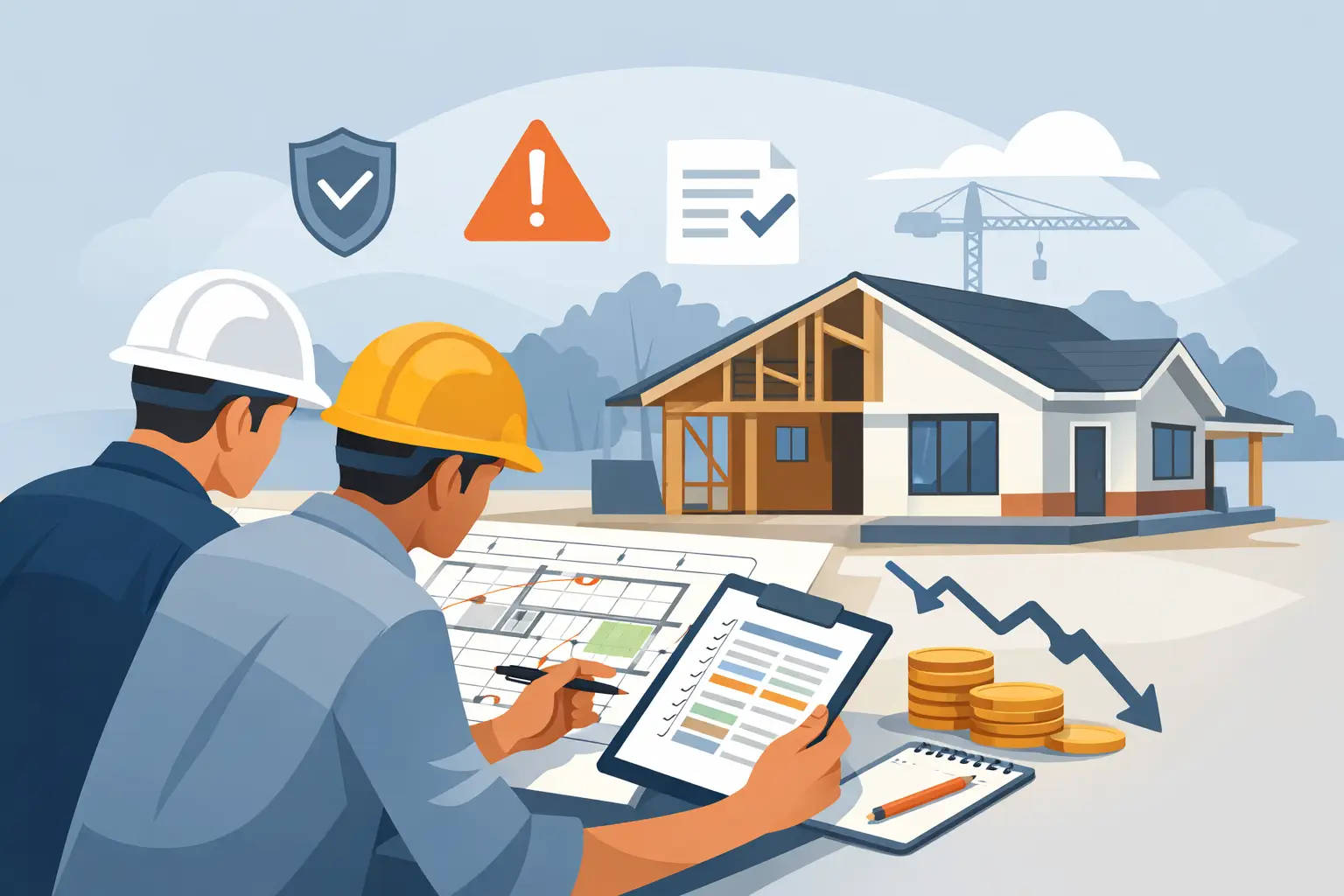
A custom home job can look straightforward on the cover sheet, then leak margin once the drawings are measured properly. That is why custom home estimating support matters at DA stage. If your team is pricing off incomplete architectural plans, scattered consultant notes and a rough internal allowance sheet, you are not just estimating slowly - you are carrying tender risk you cannot see.
For custom builders, the problem is rarely one big miss. It is the accumulation of small scope gaps, soft provisional allowances, trade packages that are not issued cleanly, and programme assumptions that never got tested against the actual build. By the time the client wants a sharpened number, your estimator or pre-con manager is already buried in take-offs, supplier calls and revision mark-ups.
Good estimating support fixes that before the tender becomes a clean-up exercise. It gives you measured scope, a BOQ structure that builders can actually work with, and outputs that move straight into pricing, trade engagement and internal review.
What custom home estimating support should actually do
A lot of services claim to help with estimating, but the real test is whether the output is builder-ready. For a custom home builder, that means more than a top-line cost plan. You need the estimate broken into sensible trade sections, measured from plans, with assumptions clear enough that someone else in the business can review, challenge and adjust it.
At minimum, custom home estimating support should convert DA-stage plans and supporting documentation into a complete pricing base. That usually means a cost estimate report, an editable BOQ workbook, subcontractor pricing packs and a basic construction programme. If the estimate cannot be adjusted easily once engineering, selections or council conditions change, it is not much use in a live pre-construction workflow.
The other key point is separation. Measured scope should sit apart from provisional allowances. When those two get blended together, builders lose visibility over where the real uncertainty sits. You end up defending a price that looks detailed on paper but still carries hidden risk in excavation, services, structural steel, site works or authority requirements.
Why custom home builders get caught out
Custom homes are not repetitive volume product. Even where the floor area is familiar, the buildability usually is not. Split levels, sloping sites, façade detailing, bespoke structural elements, higher-end selections and consultant-driven changes all affect cost in ways that broad rate-per-square-metre shortcuts simply cannot handle.
That is where many internal estimating workflows start to strain. A small-to-mid-sized builder might have one estimator, or a director still doing final pricing review at night. The team can price a job, but the process is too manual. Plans are measured by hand or in take-off software, rates are pulled from old jobs, and trade packs go out late because the BOQ was not built for subcontractor use in the first place.
The result is not always a bad estimate. More often, it is an estimate that took too long, relied on too many assumptions, or left too little time for market testing. In a tight tender window, speed matters because it buys you review time. Review time is where margin protection happens.
The value of measured scope over broad allowances
One of the biggest gains from proper custom home estimating support is that it forces scope visibility. When materials, labour and quantities are measured directly from the plans, the conversation changes. Instead of arguing about whether the estimate feels high or low, your team can look at specific line items, challenge rates, and test alternatives.
That matters for value engineering as well. If a client needs the number reduced, you cannot make sensible changes from a lump-sum allowance sheet. You need to know where the money is sitting - framing, cladding, wet area finishes, glazing, external works, joinery, preliminaries. A structured BOQ gives you that.
There is also a commercial discipline benefit. Builders who price from measured scope tend to issue cleaner subcontractor packs and get more comparable returns. Trades can price against clearer quantities and assumptions, which reduces the usual back-and-forth over what was or was not included.
What a useful estimating workflow looks like
For low-rise residential work, the best support model is fast enough for early decisions but detailed enough for tender readiness. That usually starts with the builder uploading DA plans, engineering if available, schedules, consultant documents and any project-specific notes about build method or expected specification.
From there, the estimating process should measure the drawings, map quantities into a trade-based BOQ, apply current rate cards relevant to the project location, and flag scope that cannot be properly measured yet. Metro and regional differences matter here. A duplex in outer Melbourne, a custom single dwelling in coastal NSW and a triplex in regional Queensland may share a broad building type, but labour and subcontractor market conditions will not be identical.
Once the estimate is built, the outputs need to be practical. The report should show cost by trade and by build section. The BOQ should be editable, not locked down. The subcontractor packs should be ready to issue with clear scope descriptions. And the programme should give enough logic to sense-check preliminaries, supervision and likely sequencing.
If any of those pieces are missing, your team ends up rebuilding the estimate manually anyway.
Where automation helps, and where judgement still matters
Builders should be wary of two extremes. At one end, a traditional manual estimate can be thorough but too slow and too expensive for early-stage decision-making. At the other, automated tools can produce fast numbers that still need heavy user input or too much estimator clean-up.
The sweet spot is automation with an estimating service layer behind it. Automation should handle the repetitive work - plan measurement, quantity extraction, BOQ formatting, dashboard totals and rate application. Human judgement still matters in reviewing assumptions, identifying likely tender gaps and deciding where allowances are appropriate.
That is particularly true on custom homes with incomplete documentation. No system can magically measure details that are not on the plans. What good support does is make those unknowns visible, separate them from measured items, and let the builder adjust them deliberately rather than accidentally carrying them inside lump sums.
How to judge if the support is commercially useful
If you are comparing options, do not just ask how fast the estimate comes back. Ask what you can do with it once it lands.
Can your team edit quantities, rates, margin and supervision settings? Can you issue the trade breakdowns directly to subcontractors? Are the provisional allowances clearly marked? Is there enough cost structure to compare against a past priced job? Does the programme align with the preliminaries and site supervision assumptions?
These are practical questions, but they tell you whether the service is helping you win work or just helping you fill a spreadsheet.
A builder-ready estimating pack should also suit different users inside the business. The estimator may want line-item depth. The director may want dashboard totals and margin sensitivity. The pre-construction manager may care most about packaging, allowances and timing. If the estimate only works for one person, it creates another bottleneck.
Why this matters more in custom work than standard housing
In standard product housing, a lot of pricing confidence comes from repetition. In custom work, pricing confidence comes from process. You do not have the luxury of relying on a near-identical past job every time. Even when a previous build looks similar, the engineering, footing solution, façade treatment, access constraints and client specification can move the cost materially.
That is why custom home estimating support is not just an admin shortcut. It is a risk control measure. It gives your business a clearer basis for tendering, cleaner subcontractor engagement and a better shot at protecting margin when the project moves from concept into contract documentation.
For builders handling multiple tenders at once, the time gain is just as important as the technical gain. If you can turn DA-stage information into a usable estimating pack in hours rather than days, you create room to review, question and refine. That tends to produce better decisions than rushing a price out the door because the measurement work consumed the whole window.
For residential builders who need that balance of speed and depth, EstiFlow sits in the practical middle ground. It turns plans and supporting documents into a complete estimating pack typically the same day, with editable BOQs, subcontractor pricing packs, dashboards and programme logic that can actually be used by a builder, not just admired by an analyst.
The real measure of estimating support is simple: when the next custom home lands on your desk, does the process give you more control or more guesswork? The builders who keep tightening their pre-construction workflow are usually the ones still standing when a marginal job turns difficult.